Non-oil export stands at $15b in near 5 months
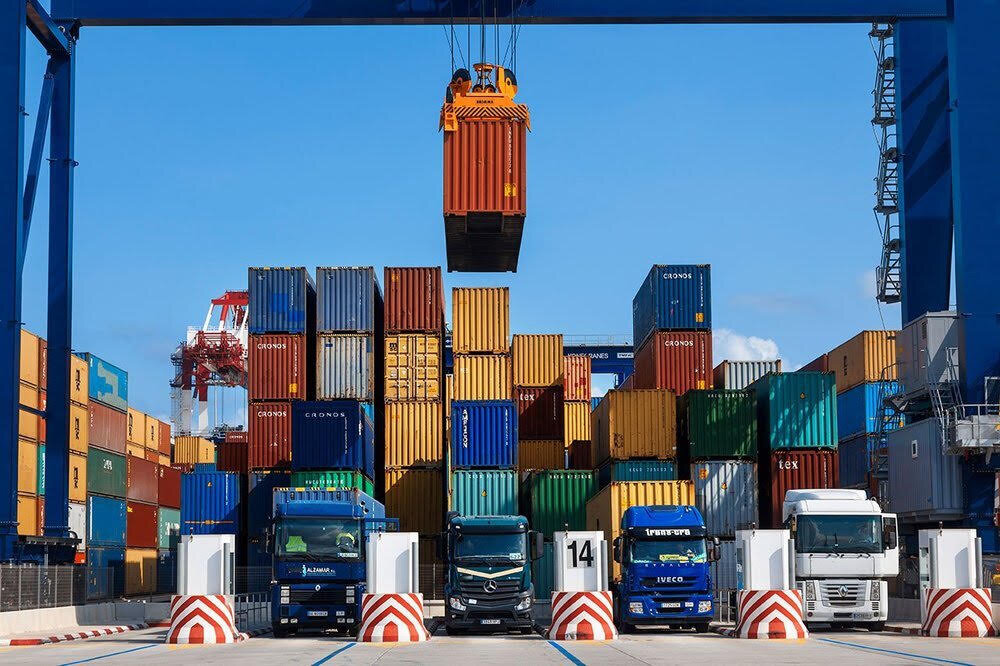
TEHRAN- The head of Iran's Customs Administration said: Non-oil exports from the beginning of this Iranian year (March 21) until August 16 have reached nearly $15 billion, and imports have reached $17 billion, although compared to the same period last year, there has been an average decline of 24 percent.
According to IRNA, Foroud Asgari said on Tuesday at the 43rd meeting of the Tehran Chamber of Commerce Board of Representatives, referring to the latest status of the country's foreign trade: In the import sector, policies have been implemented in such a way that goods with foreign currency priority are at the top, and for this reason, imports of some unnecessary or low-priority items have decreased.
Asgari, referring to the decline in mobile phone imports, stated: In the first five months of last year, about 3,160,000 mobile phones were imported into the country, but this year, imports of this product reached 1 million devices, which in terms of value has decreased by about 70 percent.
The head of Iran's Customs Administration emphasized: Currently, the priority of the Ministry of Industry, Mining and Trade is to supply raw materials needed by production units, and for this reason, the focus of import policies is on goods that directly play a role in the production cycle.
Referring to car import statistics, he said: So far, 25,000 cars have been cleared, which shows a 67 percent growth compared to the same period last year.
The head of Iran's Customs Administration referred to the situation of essential goods in the country's ports and said: Of the total imports of 39 million tons, about 9.5 million tons are related to essential goods, of which 4.5 million tons are currently available in 13 ports of the country.
According to him, of this amount, about 3 million tons of essential goods are stored in Imam Khomeini Port and about 1 million tons in 12 other ports.
Asgari added: Currently, 145,000 tons of goods are being unloaded, and about 500,000 tons are waiting for unloading at anchorage.
Emphasizing the need to facilitate port and customs operations to meet the country's needs in a timely manner, he noted: Iran's Customs is trying to ensure that the clearance process for essential goods and priority items continues without interruption.
The head of the Customs Administration of the Islamic Republic of Iran, explaining the set of measures taken to facilitate foreign trade and reduce barriers to goods clearance, announced the formulation and follow-up of new packages in the customs sector, the extension of emergency permits until the end of September, and some reforms aimed at accelerating the delivery of goods to production units.
Appreciating the efforts of merchants and those involved in this sector under difficult circumstances, he stated: All emergency permits that were valid until June 14 have been extended until the end of September with government approval.
Asgari added: This includes various approvals that have been approved or communicated in the form of 65-item, 12-item, and 11-item customs packages, and economic operators can take advantage of these capacities until the end of September. In recent months, efforts have been made to remove some of the obstacles in the path of foreign trade and goods clearance by using legal capacities and obtaining permission from competent authorities, so that goods can enter the production and consumption cycle more quickly.
He continued: In this process, there was good empathy and cooperation among the authorities responsible for issuing legal permits, including the National Standards Organization, the Ministry of Health, the quarantine sector, environmental agencies, and other bodies, and this coordination helped resolve some administrative bottlenecks in the goods clearance process.
The head of Iran's Customs Administration, referring to some obstacles arising from procedures, legal requirements, and systems, said: In cases where existing formalities led to delays in the trade process, we tried to provide operational solutions to overcome these obstacles by obtaining permission from higher authorities, including in the areas of tracking codes, goods valuation, tariffs, order registration, and other issues that economic operators face in the systems.
Asgari stated: Within this framework, 6,300 cars were released from the country's customs without tracking codes, for which necessary permits were obtained from the Supreme National Security Council and the Central Bank to allow these vehicles to be cleared.
He continued: Also, in some cases, due to special circumstances, the required permits were obtained for the clearance of goods from various regions and entry points, and these measures overall helped smooth out some commercial processes.
----------------------------Formulation of a proposed customs package before the crisis
The head of Iran's Customs Administration, stating that customs had previously anticipated the possibility of some crisis conditions and their effects on trade, said: Accordingly, a set of proposals and solutions was prepared in the form of an expert package to identify potential obstacles to foreign trade and goods clearance and to decide on removing them.
He added: This package was compiled and submitted to relevant officials for review and decision-making. Its text was also sent to a number of representatives and private sector activists, including chamber of commerce officials, so that they would be informed of customs' direction for facilitating trade.
According to him, these proposals have a total of about 30 clauses, most of which relate to the government and are scheduled to be reviewed in the Economic Commission meeting. The goal is for goods to reach factories, production units, or consumption points as quickly as possible and to prevent unnecessary stoppages, cost increases, and accumulation at entry points.
The head of Iran's Customs Administration stated that one of the key axes of this package is the principle of non-stoppage of goods at border entry points, and said: Based on this approach, only primary controls such as quarantine, health, and environmental checks are performed at the border, and other permits and complementary processes can be pursued subsequently without unnecessarily holding up the goods.
He added: Numerous meetings have been held with officials of relevant bodies, including in the areas of standards and health, and the necessary approvals have been arranged. According to Asgari, if this bill is finalized and goes through legal procedures, a major transformation will occur in the goods clearance process.
Asgari, referring to one of the important problems at the country's entry points, stated: One of the reasons for goods stoppage is the multiple sampling by various agencies. Accordingly, it was proposed that a specific timeframe be set for sampling, and that samples taken at the border be examined and tested during the transit period or at the destination.
He explained: For example, if goods enter through the border and are transited to a destination like Isfahan, the tests related to the sample taken should be conducted while the goods are in transit. If the relevant authority fails to conduct the test or announce the result within the stipulated time, the goods should not remain at the border for an extended period. In some cases, it has also been proposed that goods be transferred to the owner's warehouse with a non-consumption undertaking, both to reduce warehousing and waiting costs and to maintain the oversight capability of the responsible authorities.
The Deputy Minister of Economy also said: Another proposal is that for goods such as wheat and similar items that require input from multiple agencies, instead of each agency taking separate samples, a single sampling be conducted at the time of the ship's or truck's presence at the border, and the result be made available to all relevant agencies.
Referring to goods subject to health and special storage requirements, he said: Some goods, if left in public warehouses or unsuitable environments, suffer quality degradation or spoilage. Accordingly, it has been proposed that such goods be kept in cold storage or the owner's warehouse under the supervision of the permitting authority until formalities are completed. This measure both helps preserve the quality of the goods and prevents additional costs from being imposed on the economic operator.
Asgari referred to another important issue for economic operators and said: One of the issues that has always caused problems for traders is the precedence of order registration over goods arrival. While the speed of goods entry into the country and logistics processes in many cases outpaces administrative bureaucracy, it is possible that goods enter a free zone, port, or border, but the order registration process has not yet been finalized.
He added: Our proposal is that if goods have entered the country and their order registration has been issued after entry, clearance should be possible provided that the necessary regulations and controls are observed. According to the head of Customs, this issue is particularly important for goods that require further scrutiny in terms of value, year of manufacture, or certain specifications, and could resolve some of the administrative bottlenecks.
The head of Iran's Customs Administration also announced the proposal of three important axes in the Economic Commission and said: One of the main axes is imports without foreign currency transfer, another is supply from one's own foreign currency, and also imports against exports.
He noted: In some cases, the requirement to obtain a source code or banking tracking codes prolongs the trade process. Therefore, proposals have been put forward in this regard that go beyond existing procedures, and decisions are to be made on them with the presence of relevant bodies including the Central Bank. In the sector of imports without foreign currency transfer and some similar methods, the Ministry of Industry, Mining and Trade has also provided cooperation, and this matter is being pursued with the proposal of relevant officials so that ultimately an implementable and reliable decision is made for economic operators.
MA
Leave a Comment